

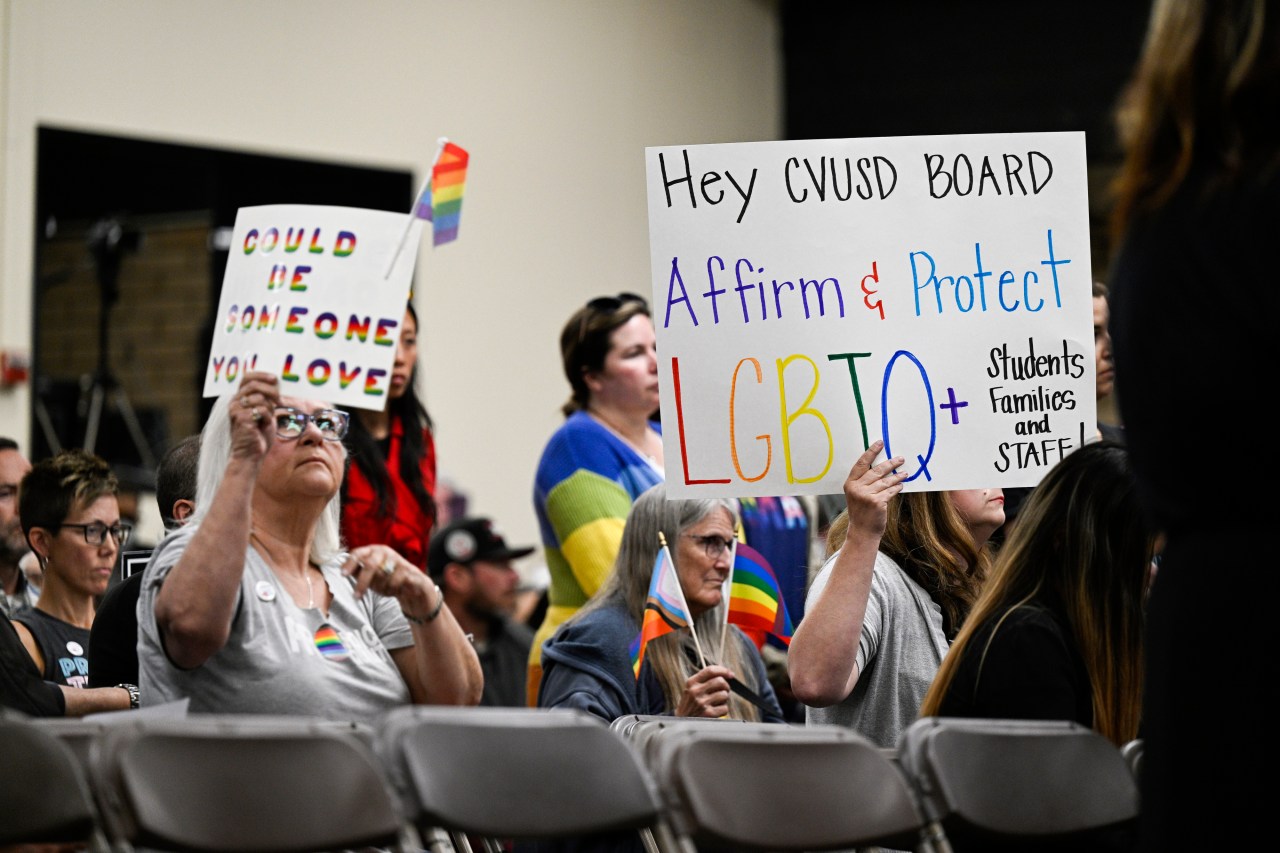
A Southern California school district sued by the state has updated its policy requiring staff to notify parents that a student is using a different pronoun or bathroom designated for another gender and now will only mention that a child has requested a change to their student records.
The Chino Valley Unified School District board approved the updated policy on Thursday as the district fights a lawsuit filed by Democratic state Attorney General Rob Bonta, who called the original policy discriminatory. Bonta on Friday did not immediately respond to a request for comment on the board’s decision.
The policy maintains part of the original rule requiring staff to notify parents within three days of their child requesting any changes to their “official or unofficial records,” although it does not specify what that would include. All references to gender identification changes have been removed from the policy.
LGBTQ+ advocates said the new mandate is simply a legal loophole to repackage the same policy that continues to violate the rights of students.
“They’re just broadening the scope so that they don’t obviously single that population out,” said Kristi Hirst, who co-founded the public education advocacy group Our Schools USA. “But the intent behind it, in my opinion, is no different.”
Both Chino’s original and updated policies include other scenarios in which school staff would have to notify parents, such as when their child is significantly injured at school. But schools already were required to report when a child’s safety is threatened.
The battle at the district in Chino, a city about 32 miles (52 kilometers) east of Los Angeles, is part of a nationwide debate over local school districts and the rights of parents and LGBTQ+ students. States across the country have sought to impose bans on gender-affirming care, bar trans athletes from girls and women’s sports, and require schools to “out” trans and nonbinary students to their parents. Some lawmakers in other states have introduced bills in their legislatures with broad language requiring that parents be notified of any changes to their child’s emotional health or well-being.
In California, proponents of the notification policies are trying to get a measure on the November ballot to require schools to notify parents if a child asks to change their gender identification at school, bar transgender girls in grades 7 and up from participating in girls sports, and ban gender-affirming care for minors.
Democratic Gov. Gavin Newsom garnered attention last year when he threatened to fine another Southern California district, Temecula Valley Unified, for rejecting an elementary school social studies curriculum that included supplementary material mentioning politician and gay rights advocate Harvey Milk. The district later reversed course.
The Chino Valley Unified board introduced its policy last summer after a Republican lawmaker was not able to advance legislation in the state Legislature, which is dominated by Democrats, requiring school staff to notify parents about their child’s request for a gender identification change.
Chino Valley Unified school board President Sonja Shaw, who helped craft the original policy, said before the vote on Thursday that the board is committed to upholding the rights of parents and prioritizing the well-being of students.
“This new policy strikes a balance between these two important principles, ensuring that parents are kept informed every step of the way,” Shaw said in a statement.
Teachers, parents and advocates who oppose the school board policy say it could put students’ safety at risk if they live in abusive households. Andrea McFarland, a high school English teacher for Chino Valley Unified, said the policy the board approved last year was unfair to teachers.
“I don’t want to be put in that place to have to choose between potentially putting a child in an unsafe position when they walk in the door at home,” McFarland said. “I don’t know what they’re walking into.”
She said the updated policy is unclear about what would be considered “unofficial records,” a term she hasn’t heard used in her 13 years as an educator.
A judge last year halted part of the policy that required schools to tell parents if their child asks to change their gender identification. He did not grant the state’s attempt in October to block another part of the policy requiring schools to notify parents about a child’s request to make changes to information in their student records.
Emily Rae, a lawyer representing the district, said the board decided to consider the updated policy in response to the judge’s rulings so far in the case.
“The district still believes the existing policy is legally defensible and constitutional,” she said in a statement.
She cited a recent ruling over a similar notification policy at Temecula Valley Unified, where a judge allowed the district to require school staff to notify parents if their child asks to change their gender identification at school.