
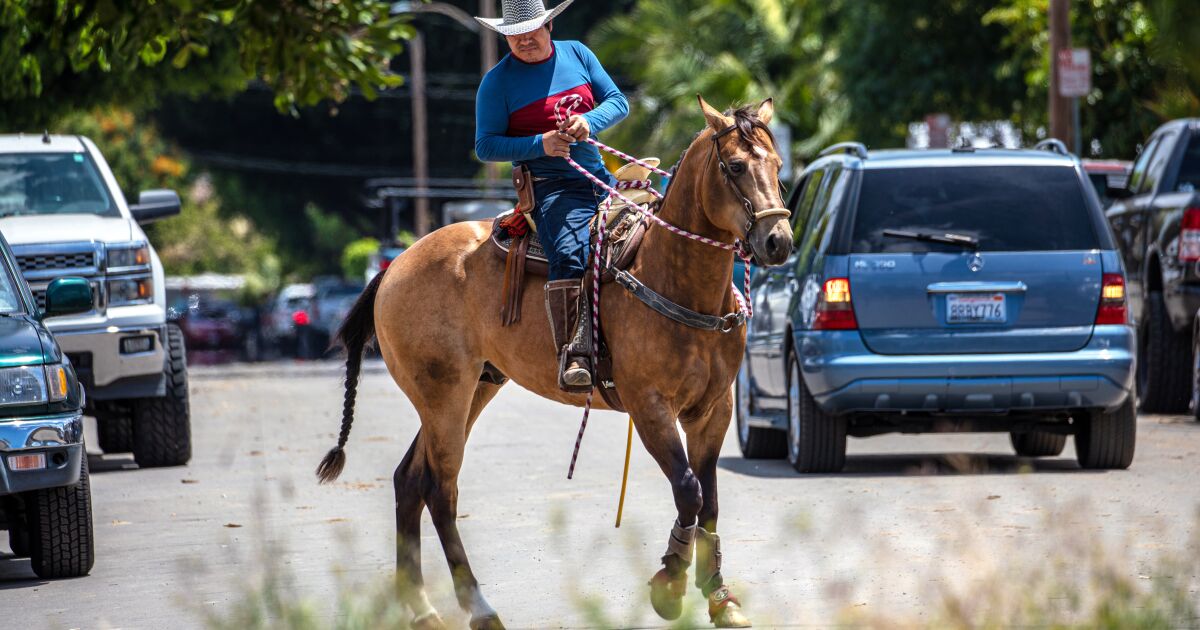
In Pellissier Village, equestrian crossing signs are as common as stop signs.
A placard on the sole bus stop warns people to not hitch their steeds to it. Horse manure plops onto the asphalt, and no one blinks or scrunches their nose.
Pellissier Village, near Whittier, is one of seven equestrian districts in L.A. County.
(Irfan Khan / Los Angeles Times)
The unincorporated community, wedged among an industrial park, the San Gabriel River, and the 605 and 60 freeways, is an unlikely sliver of horse heaven in suburban San Gabriel Valley. It’s one of seven equestrian districts in L.A. County, where any household can keep a horse without meeting a minimum lot size requirement.
Agustin Luna moved here 26 years ago, seeking the rural feel of his native Zacatecas. He joined other Mexican families who were beckoned by the proximity to other horsey neighborhoods and to the Pico Rivera Sports Arena, Southern California’s cathedral for the Mexican equestrian lifestyle. From here, it’s a short gallop to trails leading to the San Gabriel Mountains and all the way to the Pacific Ocean.
So many came, in fact, that the singing horseman playing on everyone’s stereos switched from Roy Rogers to Antonio Aguilar, and celebrations for the Virgin of Guadalupe replaced Frontier Days.
Luna became the neighborhood blacksmith, gladly nailing horseshoes for anyone who needs them.
“It’s been beautiful here,” the 68-year-old told me in Spanish as we stood in front of Placita del Pueblo, the community’s plaza.
The day I met him, though, he wasn’t happy.
In his hand was a notice of violation sent in March by the county Department of Regional Planning. Officials are threatening to fine him more than $4,000 for what they claim are illegally built horse stables, and an additional $1,000 for every day he’s not in compliance. He could also face criminal charges that could lead to six months in jail.
“They want me to buy stables that will cost me $15,000 apiece,” Luna scoffed. “I could build one for $3,000.”

Residents from equestrian communities across Southern California gather in Pellissier Village to discuss code enforcement, which they say has ramped up as the COVID pandemic has scaled down.
(Irfan Khan / Los Angeles Times)
Neighbors nodded in frustrated agreement. They gathered Saturday morning along with other horse owners from across Southern California to gripe about code enforcement, which they claim has escalated as the COVID-19 pandemic winds down.
The neighborhood’s housing stock is modest and affordable, unlike other horse-loving communities such as Norco or La Habra Heights. Residents are concerned that, amid an extreme housing shortage and a mandate by Sacramento to fix that issue, county officials want to rezone the area to allow more development and destroy their equestrian way of life.

Benny Segura, on his horse Blakon, listens to speakers at the Pellissier Village gathering.
(Irfan Khan / Los Angeles Times)
Jose Acosta described how county workers entered his property when his teenage son was home alone. Benny Segura, towering above us on his stallion Blakon, smirked.
“If you have a beer in your house, they say you have a cantina,” he said. “If you have a chicken, you have a farm. If you have a glass of milk, you have a dairy.”
Blakon clopped his front hooves on the pavement after every point Segura made.
“The problem,” Luna drolly continued, “was that there was no problem, so they [the planning department] had to go look for them. They attack us like we’re banditos, like we’re thugs. They’ve been taking advantage of us one by one.”
Code enforcement officers told Agustin Valdez that his lot in South El Monte, an unincorporated area that is not an equestrian district, is 400 square feet too small for his four horses.
“They suggested I buy the property that’s missing from a neighbor to get to code,” he said. “Who’s going to sell me something that small?”
He handed a binder of documents about his case to Baldwin Park resident Abby Lara, whose horses stay in La Puente because her hometown doesn’t allow them at all.
“I want to buy a house, but I don’t trust that the county will allow me to keep horses, even if I follow the law,” she said. “Code enforcement creates fear upon the people, but they also stress out the animals.”
Out in Riverside County’s Jurupa Valley, Uriel De La Torre said, horse owners face a different problem.
“We’re being swallowed up by pavement and warehouses,” said De La Torre, a paralegal who has lived there for 15 years. He showed up with about a dozen of his friends to offer support to Pellissier Village. “Politicians don’t care about our lifestyle. They care about the almighty dollar.”
The gathering was spearheaded by Avocado Heights Vaquer@s, an environmental justice group in the equestrian district of the same name that’s a 40-minute horse ride to the east. Members have the last couple of years fighting the proposed expansion of a battery smelter in the City of Industry but are now also focusing on protecting Pellissier Village and other equestrian communities, arguing that to target them is classist and racist.
“I thought, ‘They’re going after [horse owners] and not the battery plant?’” said Samuel Vazquez, a lead organizer and a horse owner. “They’re going after working-class communities and ignoring the elephant in the room?”
Avocado Heights Vaquer@s helped organize a town hall on April 19 attended by representatives from the L.A. County Sheriff’s Department, the Department of Regional Planning, the district attorney’s office and Supervisor Hilda Solis’ office.

People listen at the Pellissier Village gathering. Residents are concerned that, amid an extreme housing shortage, county officials want to rezone their area to allow more development.
(Irfan Khan / Los Angeles Times)
For over an hour at San Angelo Park in Avocado Heights, more than 100 angry residents from equestrian neighborhoods demanded answers about their future. A week after the meeting, the planning department announced a 120-day moratorium on code enforcement inspections in Avocado Heights while it reviews “policies and procedures.”
David Muñoz, the department’s supervising planner for the eastern San Gabriel Valley, admitted to me that the county is looking into land-use changes in other parts of Avocado Heights to “increase housing opportunities.”
But he maintained that decisions are being made with community input. All zoning enforcement is “complaint driven” and not part of a grand conspiracy to drive out horse owners, he said.
He wouldn’t elaborate on the reasons for the moratorium in Avocado Heights, but said none are planned in other unincorporated areas, including the equestrian districts, most of which are near the San Gabriel River, with two around Altadena.
Planning department documents already show staff recommendations that unincorporated pockets of Hacienda Heights, Rowland Heights, Industry, San Dimas and Covina be rezoned from agricultural to residential.
In a statement to The Times, Solis said she’s calling more meetings to serve as “a perfect opportunity to ensure necessary code enforcement activities are handled equitably and with an understanding of the communities they serve.”
Any final zoning changes are years away, and there are no immediate plans to suburbanize Avocado Heights and Pellissier Village. But residents believe something is afoot.

Manuel Plascencia speaks at the gathering as Samuel Vazquez, right, listens. The two are part of an environmental justice group in nearby Avocado Heights and came to Pellissier Village to offer support.
(Irfan Khan / Los Angeles Times)
The atmosphere at Placita del Pueblo was like a rancho libertarian version of “Yellowstone.” There were charros and women riders who belong to mounted drill teams. Politicians and plain folks. Elders chatted with teenagers practicing rope tricks. Attendees wore straw cowboy hats or fancy baseball caps, checkered button-down shirts or Carhartt polos. Boots, ornate belts, jeans. and mustaches were as common as good manners.
The scorn for city slickers and inept bureaucrats was as heavy as the Chalino Sánchez corridos blasting from someone’s iPhone.
Before a rose-covered shrine to the Virgin of Guadalupe, Vazquez and his sister Elena began the gathering. After a brief introduction and a suggestion that anyone who didn’t understand Spanish sit up front for the English translation, Vazquez handed the mic to Jurupa Valley Councilmember Armando Carmona.
“How many of you know people who moved to Jurupa Valley because they couldn’t keep horses in L.A. County anymore?” he asked the crowd. Many raised their hands. He then announced that the equestrian way is under attack there as well.

From Pellissier Village, it’s a short ride to equestrian trails leading to the San Gabriel Mountains.
(Irfan Khan / Los Angeles Times)
“They want to get rid of our way of life,” Carmona said, never defining who “they” were. “They blame us for not wanting to sell our homes so they can build luxury condos. They want to make us a renter community, not a homeowner one.”
Vazquez adjusted the volume on the PA system to make sure that people who had arrived late on their horses could hear. He asked who had dealt with code enforcement recently. Almost everyone raised their hands.
Did they show up with a warrant? No.
Did they show up with an official complaint? No.
Did they alert you about your legal rights? No.
“That worries me,” Vazquez said.
Elena Vazquez handed out business cards printed in English and Spanish with the 4th and 5th amendments, which protect against unlawful searches and self-incriminating testimony. Each side had the same drawing of a horse.
“We can’t be, ‘To hell with your damn codes,’ ” her brother continued. “We want to be good. But when people come and disrespect us, what are we supposed to do? We need to know the code better than the code enforcers. It’s difficult, but it can be done.”

Lalo Solis, right, and other residents from equestrian communities across Southern California listen at the gathering, which ended on an optimistic note.
(Irfan Khan / Los Angeles Times)
The meeting ended after about an hour with plans for the future. A fund to help people pay fines. A request that each community pick captains for better strategizing. A cabalgata — a procession on horseback — at an undetermined location to draw attention to the issue, with riders from across the state. A sign-up sheet to keep everyone informed.
The atmosphere, formerly tense, was now relaxed — optimistic, even. Many people lined up at a table where Elena Vazquez and another volunteer scanned their citations. The Joan Sebastian banda classic “Amor Limosnero” — “Beggar’s Love” — played.
Nearby, Pellissier Village resident Samuel Barragán pulled a wagon that held his daughter Valentina and fact sheets about horse ownership codes in L.A. County. A truck drove past with a flatbed full of hay bales. Nearby, a family walked a horse past all the parked trucks on the street, on their way to the trails.
“We can live anywhere, but we want to be here,” Barragán said. “We don’t want to fight. We just want to be left alone.”