
While much has been written about blue-chip galleries setting up shop in Los Angeles since the pandemic, from David Zwirner to Perrotin, smaller international outfits are also flocking to the City of Angels. One is the Cape Town–based Southern Guild, whose LA outpost makes it one of the few Africa-founded galleries to have a presence in the United States.
Located in Melrose Hill (a real-estate term that refers to a neighborhood better known locally as East Hollywood), Southern Guild’s space is near Zwirner, Morán Morán, James Fuentes, and Rele, which was founded in Lagos in 2015. Other galleries are a short drive away.
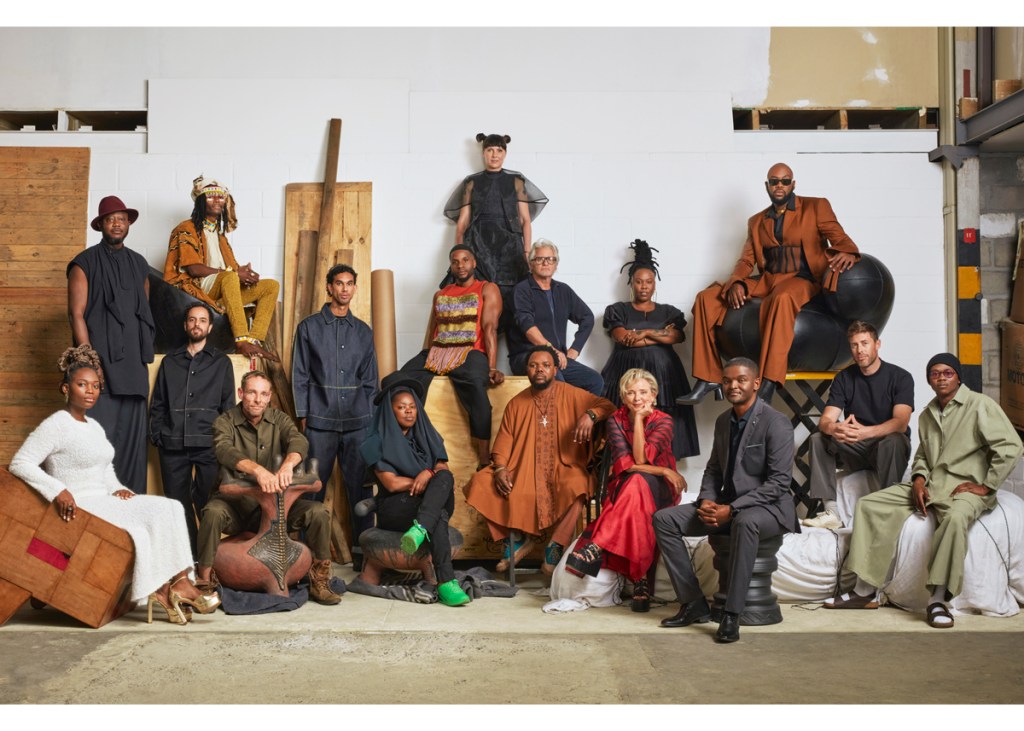
Taking over a 5,000-square-foot former laundromat, Southern Guild is opening with two exhibitions, a solo show for Zizipho Powsa, whose recent residency in Long Beach was a catalyst of sorts for the gallery’s expansion to LA, and a group exhibition titled “Mother Tongues,” featuring 26 artists on the gallery’s roster, including Zanele Muholi, Andile Dyalvane, Manyaku Mashilo, Jody Paulsen, andJozua Gerrard.
To learn more about Southern Guild’s history and expansion to LA, ARTnews spoke with Trevyn McGowan, the gallery’s cofounder and CEO, during a walkthrough of the gallery’s new outpost in LA.
This interview has been edited and condensed for clarity.

Zizipho Poswa with her sculptures at Southern Guild’s new LA space.
Photo Elizabeth Carababas/Courtesy the artist and Southern Guild
ARTnews: How did your expansion to Los Angeles come about?
Trevyn McGowan: We arrived in January [2023], thinking: We’ll see what this feels like. I had this singular vision: we’re opening in America, we’re opening in LA, and we’re opening like soon as we possibly can. We were introduced to this space by very close friends, the Haas Brothers. The whole idea of what they are doing here, how community-focused this development is, how visionary Zach Lasry has been in trying to create something that breaks the difficult parts of LA while embracing the best parts of LA, I think that’s what he’s achieved in Melrose Hill. The people who have been attracted to the district are likeminded in their desire for community, collaboration, breaking that stereotype of hierarchical monolithic galleries.
Had you traveled to Los Angeles a lot previously to deciding to open here in late 2022?
I had not. I’d been to LA twice, once in 1986 and once in 2011. But we had been talking to [ceramicist] Tony Marsh about Zizipho Powsa doing a residency here [at the Center for Contemporary Ceramics at California State University, Long Beach]. She was invited to do the residency in 2018. It was going to be in 2019, then it was pushed to 2020, and we were going to do a three-month pop-up and just hang out in the city. I had a little fantasy in the back of my head [about opening here]. It’s a very romantic city for me, especially the hills and the art history of the ’60s.
We were also spending so much time in Miami, Chicago, and New York. We love all those cities, but none of them felt like it would make sense. We struggled to see how we would fit into New York, even though we did a fantastic show last April, with Galerie 56 and [founder] Lee Mindel for Zizipho Poswa, and we’ve got another one opening April 30, called “No Bats, No Chocolate” with Porky Hefer. Look, the client base in New York is extraordinary. Nobody is going to debate that. But we’re happy to have a longer, deeper, more engaged way of working with people. Those relationships feel like they could be quite authentically developed in this city, potentially more so than in New York. There’s so many people here that feel authentically aligned with what we’re doing.

Julian and Trevyn McGowan.
Photo Elizabeth Carababas/Courtesy Southern Guild
What about LA felt right? Is it a similar vibe to Cape Town, where the gallery is based?
LA’s a bit of a mixture between Cape Town and Johannesburg, but it’s more like Johannesburg, which is where I’m from. The cities are very similar in age. They were built up for the same reasons—people heading west [in the US] and people heading north [in South Africa] who were literally pioneering. The architecture has a lot of similarities, with its hodgepodge nature. The plants are exactly the same; the weather is very similar. The only thing that we don’t have in Joburg are mountains and palm trees—that’s Cape Town. But LA has that kind of hustle and bustle, friendliness, and openness, and that wanting to make things happen, so that all felt very familiar.
But we also need a space that is as big as this. This is how big our gallery is in Cape Town. Whenever we do booths at fairs, we get very big booths because the work we show is big and the scale of our vision is large. People’s houses are bigger here, people are more experimental.
What made you want to start Southern Guild 16 years ago, and what was South Africa’s art scene like at the time?
Julian [McGowan, the gallery’s other cofounder] and I tend to be quite impulsive. We bought a house in three days [in the early 2000s] when we moved back to South Africa in a place called Wilderness, six hours outside Cape Town, on the spur of the moment after living in London for 22 years. I got back to South Africa after being away for 22 years. Julian was an acclaimed theater designer in London, and I had had an architectural and interiors practice. When we got back to South Africa, on the holiday that we bought the house, I was aware of this incredible creative capacity of people making things there.
In London, I had been sourcing pieces from South Africa. I just realized that there were things going on that were very different there than they were anywhere else. It wasn’t a logical or commercial decision to start a business doing this. It was a passion—falling in love with the makers, the artists, the creatives, and wanting to articulate what they were doing, and be the conduit for them to a global audience.

Installation view of “Mother Tongues,” 2024, at Southern Guild, Los Angeles
Photo Elizabeth Carababas/Courtesy Southern Guild
It was true that that we learned a language that we wanted to help articulate. There wasn’t a collectible design industry on the African continent, really. And to be honest, I didn’t even know that there was such a thing [elsewhere]. We launched in 2008, and our first big exhibition featured 36 designers at the Joburg Art Fair. Then, nine months later, I went to Design Miami/ and realized, Oh, so this is actually a thing that works in this category. So, it started from an impulse and a passion and just being blown away, rather than sort of sort of calculated. We helped to articulate and propel that category absolutely.
We have continued to help facilitate people making and collaborating. We’ve got a residency program. We’ve got a big campus that measures around 32,000 square feet. Some of our artists have their studios there, with the ceramic kilns and painting studios. There are also two bronze foundries. We’re located in the ports in a dead end, so we’ve got this whole street with five different buildings, with all of this creative community going on. We help to produce for international artists. We’ve collaborated with Marc Quinn, the Haas Brothers, Misha Kahn, and other makers here. We really are a bonded pack and a family. A lot of our artists have been with us from the beginning. It has been a wonderful thing to be part of a guild that’s supportive and holding each other up.
We showed contemporary art right from the beginning in 2008. At that time, we made a rule that it was going to be three-dimensional, so it would be wall hangings or sculptural objects. We simply wouldn’t show painting. Then about six years ago, we were like, Why did we put this binary in place? As we progressed, the design has become less furniture—not that it was ever classic furniture. The works we show have become more sculptural, more abstracted, and more things that you interact with rather than just use.

Installation view of “Mother Tongues,” 2024, at Southern Guild, Los Angeles
Photo Elizabeth Carababas/Courtesy Southern Guild
How has the gallery grown since its founding?
About six years ago, we expanded quite dramatically. There are 36 people on our team in Cape Town, and there are four in LA already. That is because of the amount of projects we do. Opening in LA feels like the next decade of major development, ambition, and desire to further broaden the particular way that we do things. I don’t think we’re the same as other galleries. We have aspects of a lot of galleries have. But, this is Southern Guild, encapsulating people who we think are contributing to what it means to be human and to address the issues of the past, what’s currently happening, and how we navigate a better future and more equitable future.
We’ve got such a scarred past coming from South Africa. A lot of our practice has to do with healing and forgiving each other’s ancestors for the responsibility they had in the past. How do we authentically try to eradicate any sense of disparity within our group and within the people that we stand amongst and alongside? Hopefully, through that articulation and through those discussions, that helps to make a difference in the world.
Are all the artists represented by the gallery based in South Africa or on the African continent? With the move to LA, do you plan to start working with LA-based artists?
Our artists are predominantly from Africa, but we also represent African diasporic artists. We’re going to do a show with Marc Quinn and Zizipho Poswa. We’re going to do a show with the Haas Brothers. But these are all people who have strong links to the continent, who are authentically working and producing there. For us to suddenly represent a Danish artist, for example, has no authenticity to it for us. But we hope to work with LA artists either who are tied to Africa through diaspora or even just through an authentic collaboration. If people want to work in Africa and we feel they add to our voice, then yes, we will [show them].

Installation view of “Mother Tongues,” 2024, at Southern Guild, Los Angeles.
Photo Elizabeth Carababas/Courtesy Southern Guild
You hinted at this before, but the gallery’s name comes from a desire to create a guild of artists, correct?
We wanted to come up with something that was about uniting a band of people who share common principles and goals. A guild, like the blacksmiths guild from 1422, is about those same principles. We think that united we’re stronger. We want to have a voice that speaks for us. With “Southern” at that point [of our founding], we wanted to articulate coming from the Global South. We wanted to get away from the idea of a hierarchical system. That goes for our team as well. We’ve got an incredibly democratic organization with people who work for us. They have a lot of autonomy, and we promote people quickly. We’re not the McGowan Gallery.
Can you talk about how South Africa’s art scene has grown over the past 16 years since Southern Guild’s founding?
One of the reasons why we didn’t open broadly across all categories when we started in 2008 was we’d been in the country for five years. We thought, We’re specialists in this arena. Let’s focus on that—nobody else is doing this. Then, the landscape rapidly grew, and fantastic younger galleries started cooperatives, curators banded together. It has become an incredibly vital and dynamic space, particularly in Cape Town, a wonderfully dynamic, creative environment. And in 2017, two contemporary art museums opened in the city, the Norval Foundation and Zeitz MOCAA, which Thomas Heatherwick designed. That’s when groups from the Tate and SFMOMA started visiting. Any creative landscape needs that kind of rigorous interaction.
The Cape Town Art Fair has gotten better and better each year. We did three booths there this year. Just in general, there is so much more activity, and it’s very interesting to see the stretch from what we would consider our masters [in South African contemporary art] to the very experimental artists, who are breaking the mold and are coming up now. As we became more authentically involved in the landscape, we saw within this whole group artists who, we believe, form a part of what our mandate is.

Installation view of “Indyebo yakwaNtu (Black Bounty): Zizipho Poswa,” 2024, at Southern Guild, Los Angeles.
Photo Elizabeth Carababas/Courtesy the artist and Southern Guild
Can you talk about the LA gallery’s two inaugural shows, a solo for Zizipho Poswa and the group show “Mother Tongues”?
Because Zizi had done this residency, it was always obvious that we would show these works here. The ceramic bases were produced at Cal State Long Beach under Tony Marsh. A lot of very famous artists, like Simone Leigh, have passed through that residency over the past 35 years. Zizi created the bronze pieces [that rest on top of the ceramic pieces] once she was back in South Africa. So they were united about a week ago. They’re inspired by her travels through Africa, through residencies she’s gone to Ethiopia and Tanzania. She has a very positive, uplifting, and visionary take on what she wants to say with the work she produces, which is about honoring greatness in the everyday—caring for objects, the hairstyles she’s worn. In a way, they represent the time that women spend in hairdressing studios and the community and bond that’s formed. It’s also about raising the objects of adornment—a simple bracelet, a comb, or an earring—that gives the wearer the ability to feel elevated, confident, regal about themselves, give them the stature. It’s this moment of pleasure, joy, and affirmation. They’re honoring these objects to this scale and this elevation. She’s saying we need to look to the everyday to realize how important we are.
Regarding “Mother Tongues,” there are 12 official languages in South Africa, but there are many more that are spoken there. It’s a country that is full of different languages and different kinds of people from different backgrounds. How do we come together as one? There are artists between the ages of 22 and 68 in the show, so it spans a lot of viewpoints and generational opinions.

Jozua Gerrard, Spiralling Enquiry, 2023.
Photo Hayden Phipps/Courtesy the artist and Guild
One of our most exciting young artists is Jozua Gerrard, who is 22 and who we’ve worked with for four years already. We showed him at Untitled in Miami Beach this past December and sold several works. The work is hand-painted on the back of glass, so it’s quite labor intensive because the paint moves. They’re photographs of his friends that he then translates into paintings. It’s on glass because it refers to how we’re always looking at things through this glass filter, via Instagram and social media.
This sculpture is by Andile Dyalvane, and it’s a topographical map, flying over the Eastern Cape, where he was born. He achieves these recesses by putting little firecrackers into the clay, and then, when it heats up in the kiln, they explode. This piece is older, from 2016; it’s one that I think is one of his most important.
A lot of what you see around us [in this exhibition] is work in which the use of material is very labor intensive. Everything has a lot of hand in it, but also reuse and repetition, like pieces by Patrick Bongoy with the inner part of tires, Usha Seejarim with clothes pegs, or Ranti Bam with glazed terracotta that is fragmented yet fine like porcelain. Or even in works by Ayotunde Ojo, who is painting his own studio. Often in his paintings, his work is half in progress behind him, so there’s this intimacy and this tenderness. Compare that to an artist like Tony Gum, whose photographs are bold and confident and are talking about the rape of the African continent: the milk bags representing money bags that become cheese and then cash. The jewels represent how we objectify the beauty of Africa when we’re not robbing and pirating its wealth of the natural resources. All of these voices come together in something that is cohesively communicating our perspective.

From left, Tony Gum: Cheese I, 2023; Milk Bags I, 2023.
©Tony Gum/Courtesy the artist and Southern Guild
What’s next for the gallery’s program?
Our second show in LA, opening on May 11, is for Zanele Muholi, who will have the whole space. Her solo show is currently on view at SFMOMA. She has her second career retrospective coming to the Tate next year. She’s very focused on education and public programming. We did a lot with 18 public walkabouts, interactions, and panel discussions for her show in Cape Town last summer last. It was a cross-section—kids, teens, people in their 20s, and established collectors— talking about sexual health, gender-based violence, empowerment as a woman, and the quality of life in where you were born in the country. People have said they leave feeling like they’ve been through some sort of therapeutic experience. We will do the same kind of programming here, which is to engage the immediate environment, the audience, the community that used to use this space as a laundromat. We invite them to come and share something that could contribute to their lives in a different kind of way.
We have found a very strong audience in South Africa, but South Africa is a very small art buying population. But we see that what we do there is very important for our community, both for our artists and for each other but also as a place of education—it’s important for us to have rigorous exhibition programming.