
While President Donald Trump has issued a flurry of far-reaching decrees during his first week in office, one relatively niche issue has received a disproportionate share of the president’s ire and attention: California water policy. That might make sense if the remedies he’s pursuing could help stem deadly fires like those that have killed at least 29 people in the Los Angeles area in recent weeks. Indeed, the president has claimed that “firefighters were unable to fight the blaze due to dry hydrants, empty reservoirs, and inadequate water infrastructure.”
But unfortunately for future fire victims, the sole apparent aim of the president’s new policies is to deliver more water to farmers hundreds of miles away from the state’s fire zones.
On his first day as president, Trump issued an executive order that directed his Interior Department to “route more water” to the southern part of the state. Then, on Sunday he issued another order that directed the department to immediately “override” the state’s management of its water, even if it meant overruling California law. The order also suggested Trump could withhold federal wildfire aid if the state failed to comply to his satisfaction.
But the new measures wouldn’t deliver any more water to Los Angeles at all. Instead, his attempt to relax water restrictions would move more water to large farms in the state’s sparsely populated Central Valley, a longtime pet issue for the president, who attempted a similar maneuver during his first term. This time he’s going further, proposing to gut endangered species rules and overrule state policy to deliver a win for the influential farmers who backed all three of his campaigns.
None of this has any relation to wildfires in Los Angeles. For one thing, the city isn’t experiencing a water shortage. It was ferocious, hurricane-force winds that fanned the Palisades and Eaton Fires — not a lack of water to contain the blazes. While some local water tanks in the neighborhood of Pacific Palisades did run out of water, that was only because the city couldn’t pump new supplies up to the hillside neighborhood fast enough to keep up with skyrocketing demand during the fire, not because there wasn’t enough water available to send there.
Even if Los Angeles were low on water, Trump’s executive orders wouldn’t help with that, because the federal government’s canal system doesn’t actually deliver any water to the Los Angeles area. More than 90 percent of that water goes to farms in the Central Valley, with the rest going to far-away cities around San Francisco and Sacramento. All this water is already spoken for, and during dry years the government can’t even fulfill all its existing contracts. The most it can do is potentially ease environmental rules that limit some of the pumping, which farmers have long opposed.
But even some farm advocates are skeptical of the sweeping scope of Trump’s most recent order, and its specious connection to wildfire.
“I am always appreciative of attempts to create more flexibility for moving water around the state, but [federal] water by and large goes to agricultural contractors,” said Alex Biering, the senior policy advocate at the California Farm Bureau Federation, the state’s leading agricultural lobby. “I don’t believe that any amount of additional water coming from the federal project would be able to be applied to stop that fire. It’s an attempt to tie water supply to a natural disaster, but those connections don’t exist in reality.”
Environmental groups, meanwhile, have blasted Trump’s attempt to strongarm California water policy, saying his most recent order would be devastating for the state’s vulnerable fish species — and the integrity of the federal Endangered Species Act as a whole.
“It’s unrecognizable as anything that anybody who knows anything about California water would write,” said Jon Rosenfield, the science director at San Francisco Baykeeper, an environmental nonprofit in the Golden State. “It’s not from this planet.
California’s water system has been the subject of heated political debate for decades. Over the course of the 20th century, the federal government and the state of California built a complex series of dams and canals designed to move water from the northern parts of the state, which see substantial precipitation and snowmelt, down to the agriculture-rich Central Valley and the Los Angeles metropolitan area. The federal government operates dams, canals, and pumping stations that push water south through the valley, and then the state operates the canal that extends down to Los Angeles. The system provides water to around 30 million Californians and irrigates around 4 million acres of the nation’s most productive farmland.
The crux of this transport system is the Sacramento-San Joaquin Delta, a sensitive marshland region where two of the state’s largest rivers converge and flow out into the San Francisco Bay. This area is also the point where endangered fish species like Chinook salmon enter from the Pacific and swim upstream to spawn. If the federal and state pumps move too much water out of the Delta for farms and cities, they reverse current flows, pulling fish toward their predators or sucking them into the pumps. This is a violation of the Endangered Species Act. One of these vulnerable fish species, the 2-inch gray baitfish known as the Delta smelt, is particularly sensitive to these current changes, and the government often limits its pumping to protect it.
On Monday night, Trump erroneously claimed in a Truth Social post that he had the military “turn on the water … flowing abundantly from the Pacific Northwest, and beyond” by activating the pumps, which had been offline for a few days for maintenance. The pumped water does not come from the Pacific Northwest, and because the federal government already controls the pumps and uses them all the time, such an action does not require the involvement of the military.
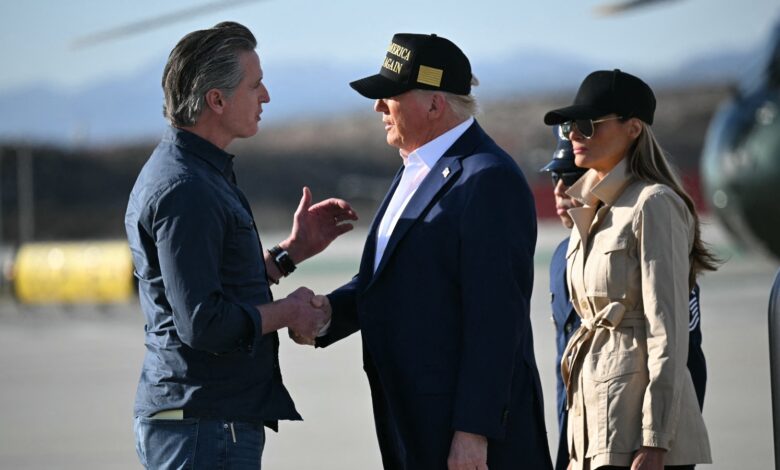
Photo by David Swanson / AFP via Getty Images
It’s California’s own state-run canal system that actually delivers water to Los Angeles and numerous other cities in Southern California — and the federal government has no jurisdiction over this. The state government curtails these water deliveries somewhat during dry years to maintain a robust supply, and it seldom provides all the water that each city requests. However, deliveries to Los Angeles were typical last year, and reservoir levels in the state are above average. (Furthermore, the Los Angeles metro gets a larger share of its water from other sources, like the Colorado River and the Owens Valley.)
Despite his East Coast upbringing, Donald Trump has fixated on Central Valley water issues for years. He chose David Bernhardt, who has lobbied for the influential Westlands Water District, to lead the Department of the Interior during his first administration. He also hosted multiple rallies in the region during his 2020 campaign, during which he frequently foregrounded water policy. During his appearance on the Joe Rogan podcast last year, then-candidate Trump led the host through a diatribe about water, describing dried-out farmland he saw while traveling through the region with Central Valley members of Congress years earlier.
“We’re driving up, and I had never seen it before,” he said. “I said, ‘Do you have a drought? They said, ‘No … in order to protect a tiny little fish, the water gets routed into the Pacific.’ So I see this, and I said, ‘You’ve got to be kidding.’”
During his first term, Trump did draft new rules in an attempt to accelerate water deliveries from the Sacramento-San Joaquin Delta. Those rules proposed that pumping should be limited only when smelt-friendly turbid waters are present in the Delta, but they also contained a few provisions that farm groups said led to wasted water during recent wet periods, and failed to prevent salmon death even by their own metrics. After Joe Biden succeeded Trump in office, the Democratic president tweaked those rules in a joint effort with the state of California — and many environmental groups have criticized Biden’s rules as worse for fish than Trump’s.
Trump may go much further this time. His most recent executive order calls for another wholesale rewrite of the pumping rules, proposes building new dams around the state, and even suggests that his administration could declare the Delta smelt functionally extinct. It also proposes to convene the federal committee known colloquially as the “God Squad,” a group of agency heads that can grant exemptions to the Endangered Species Act. This has only happened a few times since the law took effect, but in theory the “God Squad” could allow the government to pump much more water to farms, even if it means jeopardizing the very existence of smelt or salmon runs — or drying out the Delta.
Some of California’s most powerful water districts, which are typically run by large agricultural landowners, have praised the executive order, although they haven’t followed Trump in connecting it to the fires. For instance, the Westlands Water District, which covers more than half a million acres on the west side of the Central Valley, said in a statement that they “welcomed” Trump’s “leadership in addressing the barriers to water delivery.”
But despite the bluster of the White House actions, it’s far from clear that any of these changes will come to pass, at least in the short term. California water is one of the most heavily litigated issues in the United States, and even small tweaks to the state’s pumping system would likely raise legal challenges.
“They can try a lot of this stuff,” said Biering, the California Farm Bureau advocate. “It’s just about: How many times do you want to get sued?”